Cue detection · in development
Cueva Pulse
Cueva Pulse listens to the decks over Pro DJ Link, works out where the builds, drops and breakdowns are, and fires your cues before they land. No timecode, no pre-programming, no change to how the DJ works.
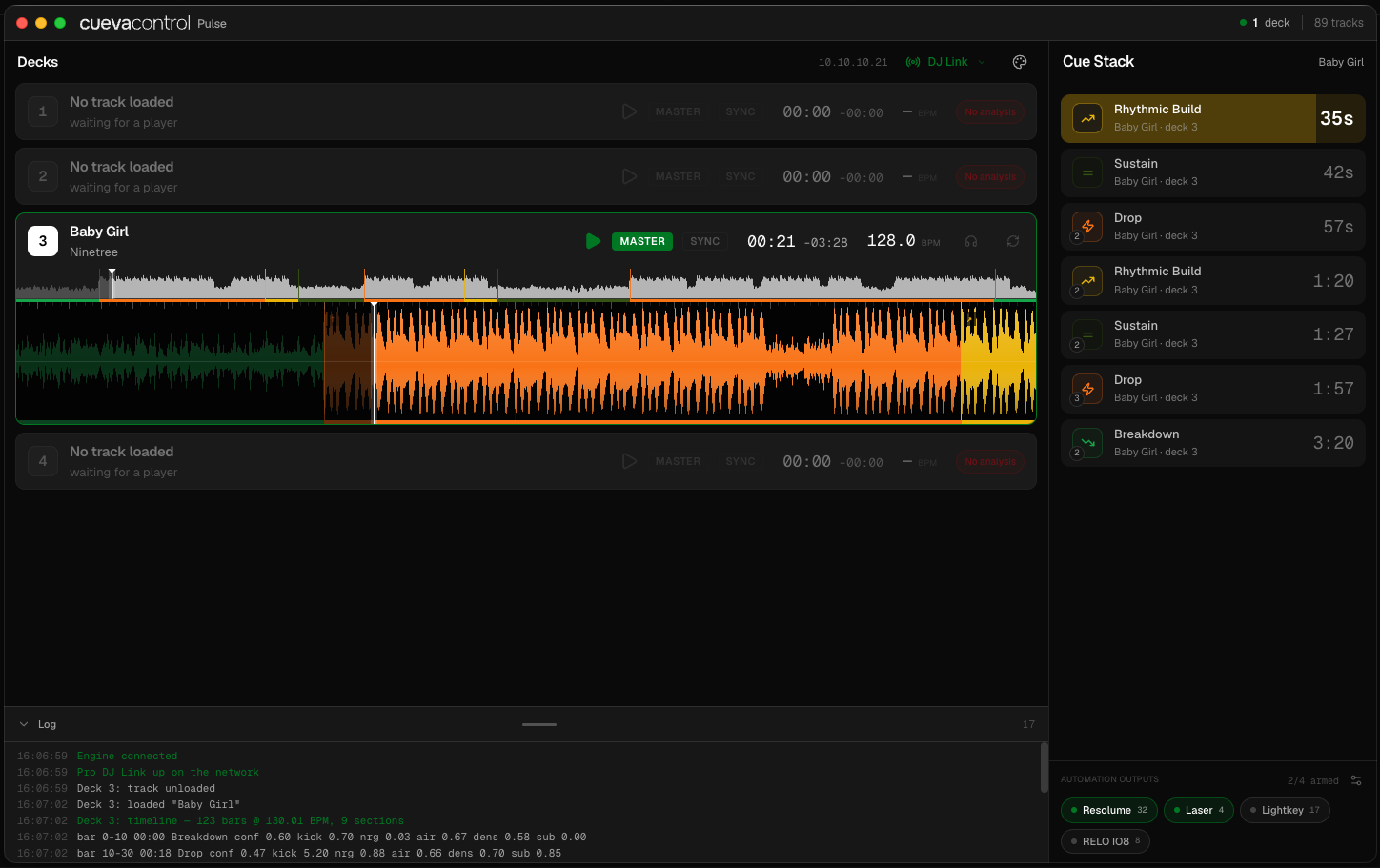 Click to enlarge
- 4
- Decks tracked
- 6
- Section types
- 4
- Output protocols
- None
- Timecode needed
- 100%
- Offline
Detection
It reads the track, not the clock.
Pulse analyses the audio the players are actually holding and marks the structure of it. The cue stack is then a running list of what happens next in the music, and exactly how far away it is.
- Intro, build, pre-drop, drop, breakdown, sustain and outro
- Fake drops flagged as their own event type
- Countdown to every upcoming section in seconds and bars
- Whole USB analysed in the background before the track is loaded
- Master deck followed automatically across up to four players
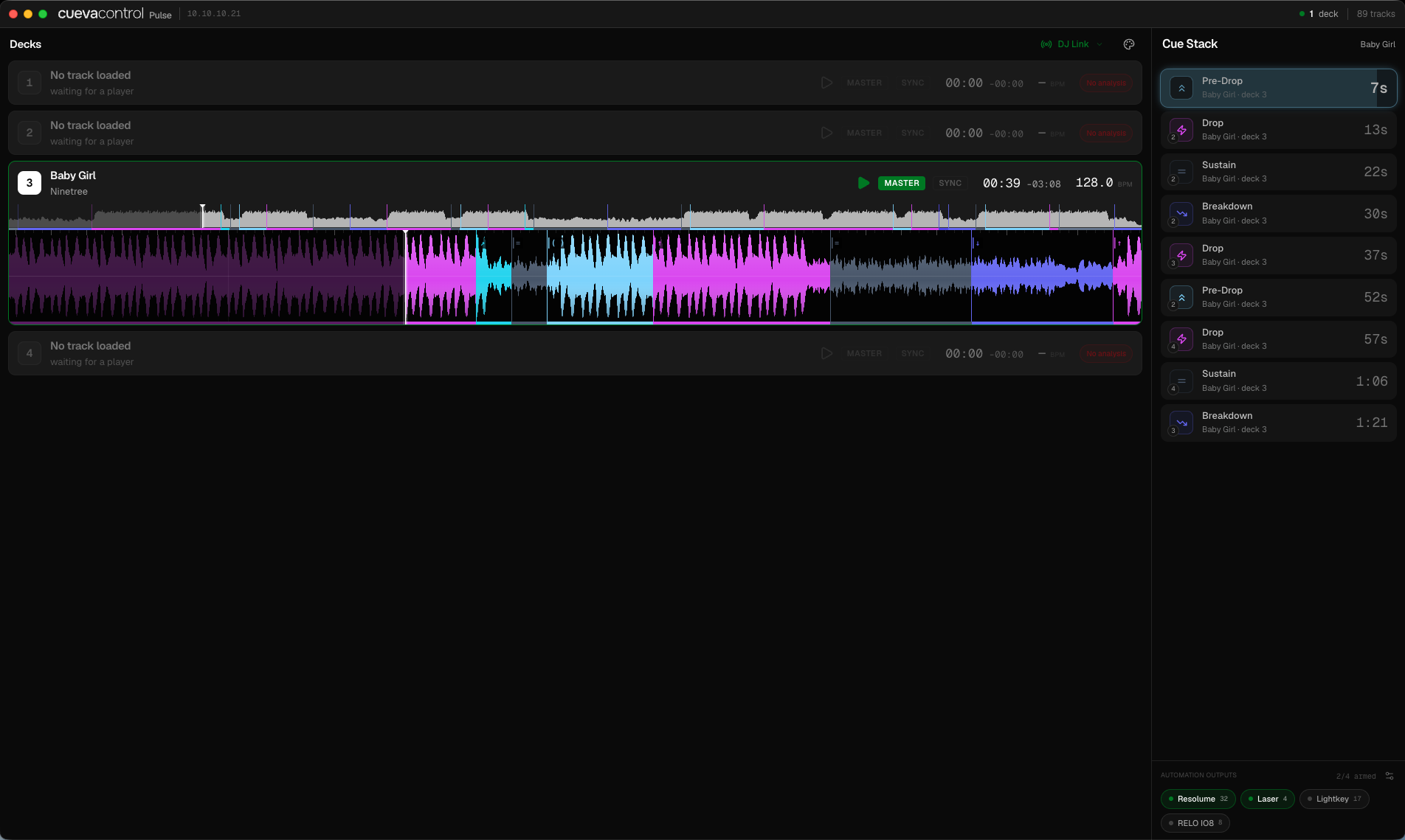 Click to enlarge
Control
Automation you can argue with.
Anyone who has been burned by an automated rig asks the same three questions: what if it is wrong, can I overrule it, and what happens when it crashes. The answers are built in rather than bolted on.
- Confidence score on every detected section, visible on screen
- Automations stay silent below the threshold you set
- Drag any boundary live, mid set, to correct it
- Corrections saved per track and reused next time it loads
- Detection engine runs separately, so a UI crash does not stop the show
Planned compatibility
Your players. Your desk.
Pulse listens on Pro DJ Link and speaks Art-Net, sACN, OSC and MIDI, so it drives whatever in your rack already takes one of those. Nothing in the booth changes, and the DJ never knows it is there.
Players and media
- Full support
- CDJ-3000, CDJ-2000NXS2, CDJ-2000NXS, XDJ-XZ
- Reduced timing
- Opus Quad, XDJ-RX3
- Why reduced
- These send no beat packets, so position is approximate
- Media
- rekordbox USB and link export
- Phrase data
- Used where rekordbox provides it
Protocols
- Player link
- Pro DJ Link over Ethernet
- Lighting output
- Art-Net, sACN
- Cue output
- OSC, MIDI
- Meaning
- Anything on your network that takes one of these
- Network
- Standard switch, no dedicated hardware
Cueva Control devices
- Direct integration
- Planned, so no OSC or MIDI layer in between
- Triggers
- Any node in a Cueva automation flow
- From there
- Actions, conditions and executions run as normal
- Devices
- Every Cueva Control device on the network
- Setup
- Devices appear as outputs in Pulse, no separate mapping
Pulse is still in development, so this is what it is being built to support rather than a tested compatibility list, and it may change before release. Direct integration with Cueva Control devices is coming too, letting a detected section trigger any node in an automation flow.
Waitlist
Pulse is not out yet.
It is in development now. The waitlist gets the beta first, and pricing when it is set.
Join the Pulse waitlist
Beta invites go out to the list first.
Questions
The things people ask first.
No. Pulse is a listener. It reads the state the players already broadcast on the network and never sends anything back to them.
No. Timecode assumes a fixed timeline. A DJ set has no fixed timeline, which is why timecode only works for pre-planned shows. Pulse follows the music as it is played.
Two safeguards. Every section carries a confidence score, and automations do not fire below the threshold you set. And you can drag any boundary to the right place live, with the correction saved for that track.
Yes, though the first pass on an unknown track is less certain than one already analysed. Pulse scans the whole USB in the background as soon as it is connected, so in practice most tracks are ready before they are loaded.
No. Detection and output run entirely on the machine, so a show never depends on a connection at the venue.
Direct integration is planned. A detected section will be able to trigger any node in a Cueva automation flow, so the whole flow editor is available to it: conditions, actions and executions, on every Cueva Control device on the network, with no OSC or MIDI layer in between. Until that lands, Cueva Control hardware is driven the same way as anything else.
Pulse is in development, so everything described here is what it is being built to do rather than a shipping specification. Join the waitlist and you will hear first when the beta opens. Pricing has not been announced.
Read more
How this compares to what you run now.
Comparison
Beat Link Trigger alternative
Beat Link Trigger fires cues from beat position and rekordbox phrase data. Cueva Pulse analyses the audio itself, so it works without phrase analysis.
Read itComparison
DJ lighting without timecode
Timecode needs a fixed timeline, and a DJ set does not have one. How Cueva Pulse triggers lighting cues from what the DJ actually plays instead.
Read itHow to
Sync Resolume to CDJs
Getting BPM, beat position and section changes out of a CDJ and into Resolume Arena over OSC, and what each of the available routes actually gives you.
Read itHow to
Trigger DMX lighting from CDJs
Getting cues out of Pro DJ Link players into grandMA, ChamSys, Avolites or any Art-Net and sACN rig, and why beat sync alone is not enough.
Read itThe drop, before it lands.
Pulse is in development. Join the waitlist and you get the beta first.