Cueva Pulse · How to
Trigger DMX lighting from CDJs, with no timecode
Getting cues out of Pro DJ Link players into grandMA, ChamSys, Avolites or any Art-Net and sACN rig, and why beat sync alone is not enough.
 Click to enlarge
The console is not the hard part
Every serious console already takes remote triggers. grandMA has OSC and MIDI and remote inputs, ChamSys MagicQ takes OSC, Avolites Titan takes both, and anything that speaks Art-Net or sACN can be driven directly. Firing a cue from outside the desk is a solved problem.
The hard part is deciding when. That decision is the operator, all night, on tracks they may be hearing for the first time.
Why beat sync does not solve it
Sending BPM to the desk so chases run in time is worth doing and most rigs already do it. But tempo is constant across a track while intensity is not. The same 128 BPM covers the breakdown, the build and the drop, so a tempo locked chase looks equally wrong in two of the three.
What changes the look is knowing which of the three you are in. That information does not exist on the network, because the players do not have it either.
Section cues into the desk
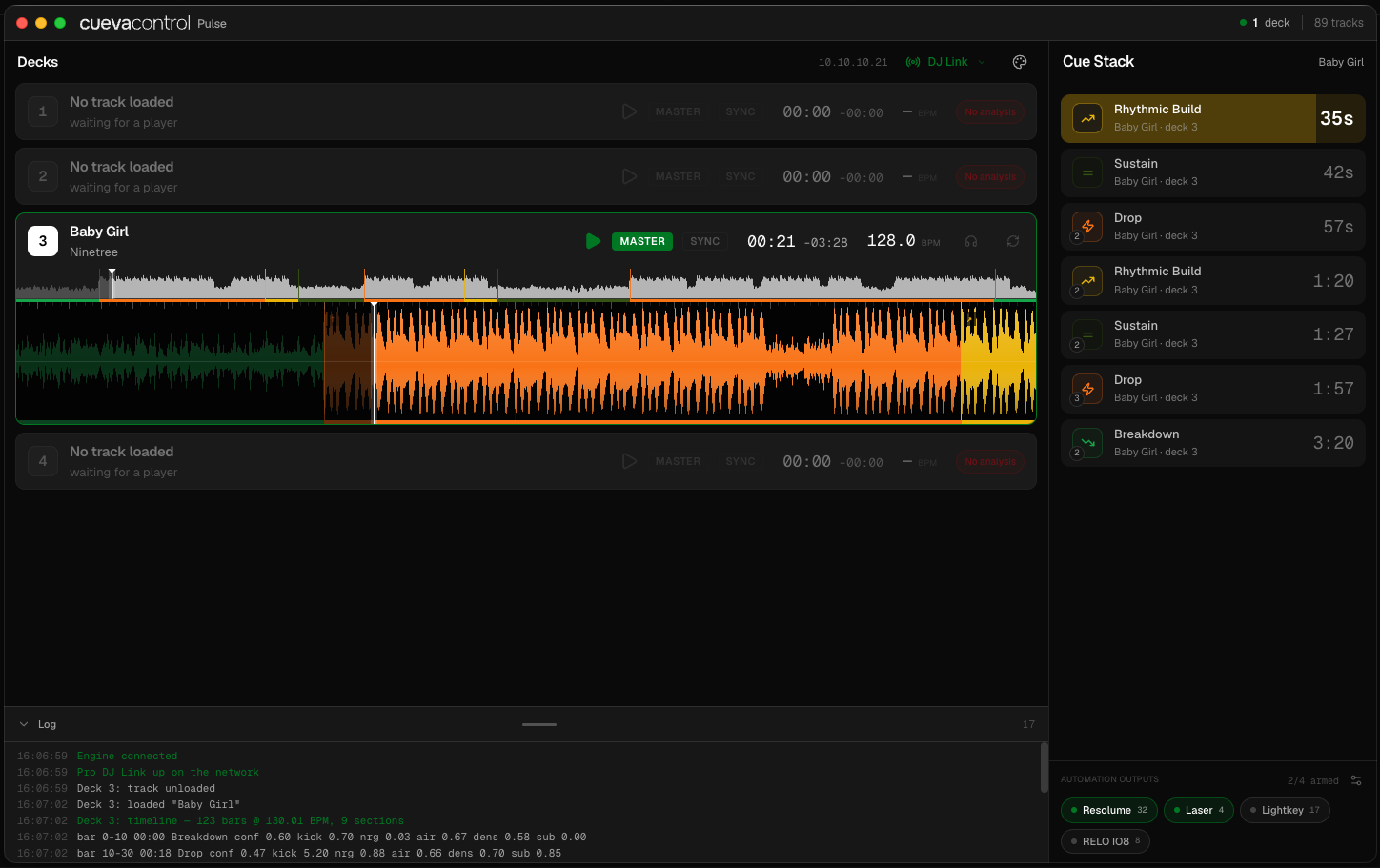
Cueva Pulse analyses the loaded track, marks the structure, and follows the playhead over Pro DJ Link so it knows where in that structure the set currently is. Section boundaries go out as OSC or MIDI to the console, or straight to fixtures over Art-Net and sACN if there is no desk in the path.
The countdown is the part that matters on a desk. Knowing the drop is 16 bars away is what lets you run a build rather than snap to a state after the fact. And because every event carries a confidence score, you can set the desk to only accept the ones Pulse is sure about and busk the rest yourself.
Side by side
Busking the set by hand versus Cueva Pulse.
| Busking the set by hand | Cueva Pulse | |
|---|---|---|
| Cues land on the drop | If the operator knows the track | Detected, with a countdown |
| Unknown tracks | Guesswork | Analysed on arrival |
| Operator required | All night | Optional |
| Fake drops | Catches most operators out | Detected as their own event |
| Consistency across a long night | Drops off with fatigue | Constant |
| Feel and taste | Human, and hard to beat | Rule based, within your thresholds |
| Console interface | Hands on the desk | OSC, MIDI, Art-Net, sACN |
Comparison correct to the best of our knowledge at the time of writing, based on each product's public documentation. Cueva Pulse is in development, so its column describes intended behaviour rather than a tested release. Spotted something wrong? Tell us and we will correct it.
Waitlist
Pulse is not out yet.
It is in development now. The waitlist gets the beta first.
Join the Pulse waitlist
Beta invites go out to the list first.
Questions
Straight answers, no sales pitch.
It replaces the part of the job that is watching a waveform and guessing. A good operator still reads the room better than any software, which is why every event can be overridden and thresholds are yours to set.
Over the network, yes, via Art-Net and sACN. For physical DMX ports you would put a node in the path, or drive your existing console over OSC or MIDI.
If it takes MIDI notes or MIDI show control, it can be triggered. That covers most consoles still in service.
Read more
Other ways people solve this.
Overview
What Cueva Pulse does
What it detects, what it connects to, how the confidence threshold works, and how to get on the waitlist.
Read itComparison
Beat Link Trigger alternative
Beat Link Trigger fires cues from beat position and rekordbox phrase data. Cueva Pulse analyses the audio itself, so it works without phrase analysis.
Read itComparison
DJ lighting without timecode
Timecode needs a fixed timeline, and a DJ set does not have one. How Cueva Pulse triggers lighting cues from what the DJ actually plays instead.
Read itHow to
Sync Resolume to CDJs
Getting BPM, beat position and section changes out of a CDJ and into Resolume Arena over OSC, and what each of the available routes actually gives you.
Read itThe drop, before it lands.
Pulse is in development. Join the waitlist and you get the beta first.