Cueva Pulse · Comparison
Automatic DJ lighting without timecode
Timecode needs a fixed timeline, and a DJ set does not have one. How Cueva Pulse triggers lighting cues from what the DJ actually plays instead.
 Click to enlarge
Timecode assumes something a DJ set never gives you
Timecode is a clock. Everything downstream follows that clock, which is exactly right for a theatre show, a corporate keynote, or a live act playing to a fixed arrangement. The show is the same length every night and the drop is always at 4 minutes 12.
A DJ set is the opposite. The track order is decided in the moment, tracks get cut halfway, loops get held for another sixteen bars because the room is going, and the same track never plays the same length twice. There is no timeline to lock to, so there is nothing for timecode to be code of.
What people do instead, and what it costs
The usual answers are busking it, tempo sync, or over programming. Busking works and always will, but it means an operator on the desk all night and it means the operator has to guess the drop on tracks they have not heard. Tempo sync keeps chases in time with the BPM, which is useful, but a chase in time with a breakdown still looks wrong because tempo says nothing about intensity. Over programming means authoring cues for every track you expect, which collapses the moment somebody plays something you did not expect.
The thing all three are working around is the same missing piece: nothing in the signal path knows whether the music is building, dropping or resting.
Following the music instead of a clock
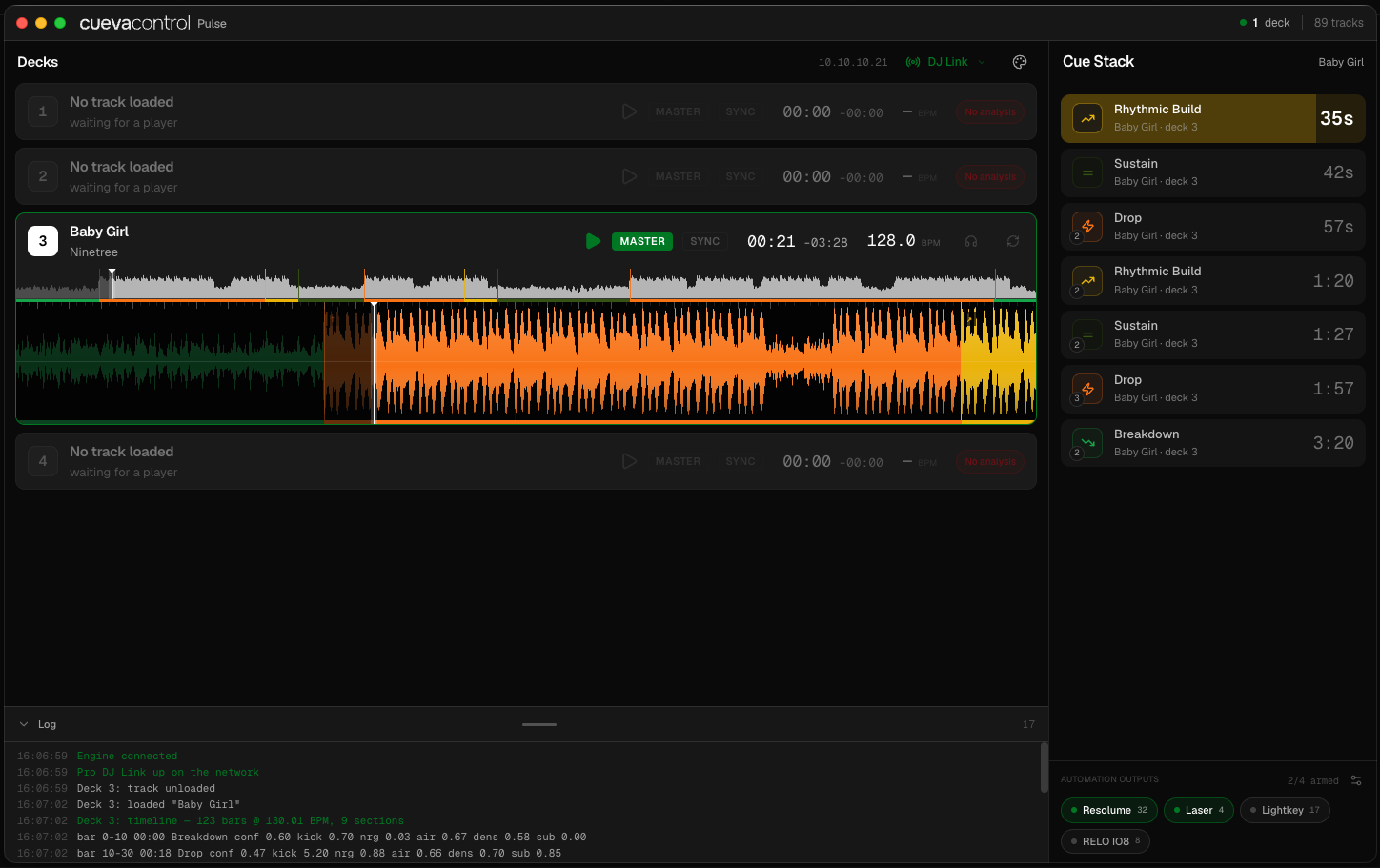
Cueva Pulse takes the track the player is on, analyses the audio, and marks the structure: intro, build, drop, breakdown, sustain, outro. It knows where the playhead is from Pro DJ Link, so it can tell you the drop is 24 bars out and count it down. Cues fire against those sections instead of against a clock.
Because the reference is the music rather than a timeline, the set can go anywhere. Cut the track at 90 seconds, loop the breakdown for a minute, drop something nobody has heard, and the cues still land where the music lands.
Side by side
SMPTE or MIDI timecode versus Cueva Pulse.
| SMPTE or MIDI timecode | Cueva Pulse | |
|---|---|---|
| Requires a fixed running order | Yes | No |
| Handles unplanned tracks | No | Yes |
| Handles loops and early cuts | Falls out of sync | Follows the playhead |
| Preparation per show | Full cue list authored in advance | Set thresholds once |
| Operator needed during the set | Yes, to nudge and correct | Optional |
| Reacts to musical intensity | Only where you programmed it | Detected per section |
| Extra hardware | Timecode generator and distribution | Network connection to the players |
| Accuracy on a rehearsed show | Sample exact | Beat exact on players that send beat packets, section detection scored |
Comparison correct to the best of our knowledge at the time of writing, based on each product's public documentation. Cueva Pulse is in development, so its column describes intended behaviour rather than a tested release. Spotted something wrong? Tell us and we will correct it.
Waitlist
Pulse is not out yet.
It is in development now. The waitlist gets the beta first.
Join the Pulse waitlist
Beta invites go out to the list first.
Questions
Straight answers, no sales pitch.
Not for a rehearsed show. If the running order is fixed and rehearsed, timecode is exact and you should use it. Pulse is for the shows where the running order does not exist yet.
Yes. Timecode for the fixed elements, Pulse for the open DJ sections. They are separate cue sources into the same console.
Set a confidence threshold and low certainty events never fire. You can also drag a section boundary live and the correction is remembered for that track.
Read more
Other ways people solve this.
Overview
What Cueva Pulse does
What it detects, what it connects to, how the confidence threshold works, and how to get on the waitlist.
Read itComparison
Beat Link Trigger alternative
Beat Link Trigger fires cues from beat position and rekordbox phrase data. Cueva Pulse analyses the audio itself, so it works without phrase analysis.
Read itHow to
Sync Resolume to CDJs
Getting BPM, beat position and section changes out of a CDJ and into Resolume Arena over OSC, and what each of the available routes actually gives you.
Read itHow to
Trigger DMX lighting from CDJs
Getting cues out of Pro DJ Link players into grandMA, ChamSys, Avolites or any Art-Net and sACN rig, and why beat sync alone is not enough.
Read itThe drop, before it lands.
Pulse is in development. Join the waitlist and you get the beta first.